
Silicone
from 350,000 KRW* VAT Not Included
This is a nasal bridge augmentation procedure that adjusts the height and length by inserting an implant into a low nasal bridge. The design takes harmony with surrounding areas, such as the forehead, nasal tip, and lips, into consideration. Silicone implants with good structural support and minimal deformation are generally used, and autologous cartilage nasal tip grafting may be performed when necessary.
Surgery Overview
Augmentation rhinoplasty is a procedure that improves a low Nasal Bridge by inserting a custom Implant beneath the periosteum to create a more defined, three-dimensional appearance. The design considers harmony with surrounding areas, including the Forehead line, nasal bones, Nasal Tip, facial contour, cheekbone height, and the angles of the lips and chin. If the Nasal Tip is low, Nasal Tip refinement may be performed concurrently.

A custom augmentation rhinoplasty that considers the Forehead–Nasal Bridge–Nasal Tip–philtrum line for a more three-dimensional, refined appearance. For low-nose rhinoplasty, the Forehead line, nasal bones, facial contour, Nasal Tip, cheekbone height, and the angles of the lips and chin must all be considered. If the Nasal Tip is low, raising only the Nasal Bridge may result in an unnatural straight nose. Therefore, the relationship between the Nasal Bridge and Nasal Tip is assessed, and Nasal Tip refinement is performed when necessary.
Opera's harmonious L-line design
Point 1. The ideal angle between the Forehead and nasal dorsum
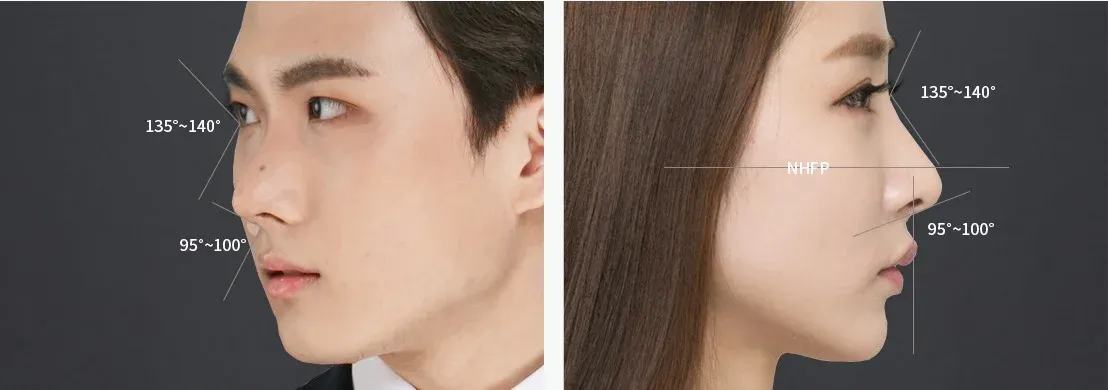
The key point of augmentation rhinoplasty is the ideal angle between the Forehead and nasal dorsum. Based on a Forehead–nasal dorsum angle of approximately 135–140° and a nose–lip angle of approximately 95–100°, a natural L-line is planned for the side profile.
Point 2. Stable results with safe Implants
Opera offers a variety of Implants, including Silicone implant, Gore-Tex, artificial dermis, and autologous dermis. Except in special cases, we generally recommend Silicone Implants, which provide good support and undergo minimal deformation after insertion. Silicone implant does not deform after placement in the body and tends to cause fewer foreign-body and tissue reactions, resulting in a relatively low risk of inflammation. Its strong support makes it suitable for achieving the desired shape and maintaining it over time. Results depend significantly more on the skill of the specialist than on the type of Implant.
Augmentation Rhinoplasty Procedure
STEP 1. Planning the incision method
The most suitable method is planned from open and closed incision techniques.
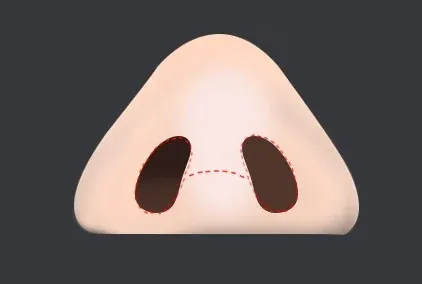
Open incision method
Incisions are made inside the nostrils and along the Columella, providing a clear surgical view for precise diagnosis and accurate Implant placement.
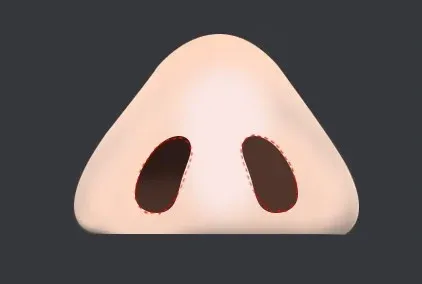
Closed incision method
Incisions are made only inside the nostrils. When there are not many areas requiring correction, the procedure can be performed by an experienced medical professional, and there are no visible external scars.
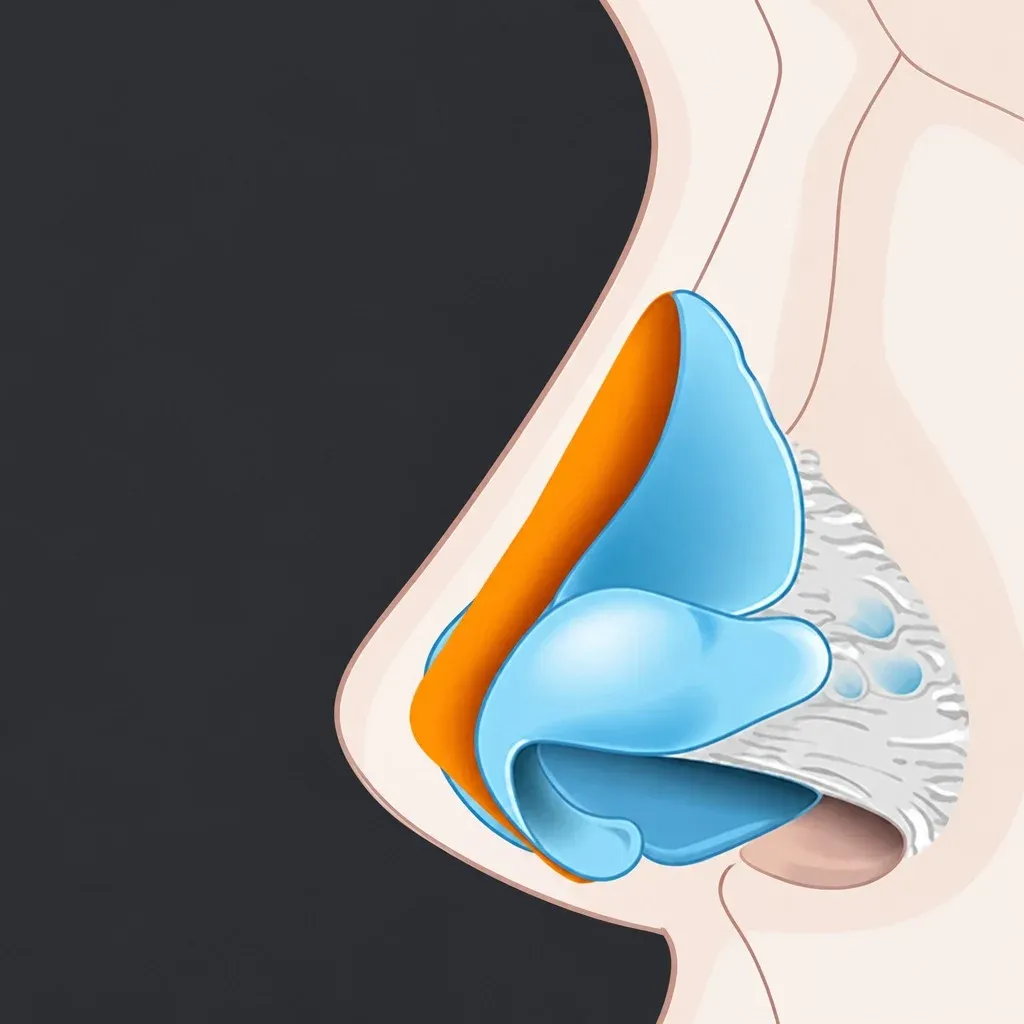
STEP 2. Insertion of a custom Nasal Bridge Implant
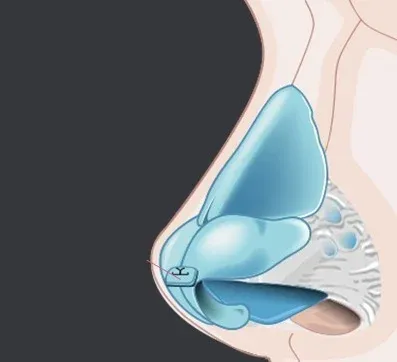
After precisely performing Dissection between the Cartilage forming the nasal alae and the skin to create space for the Implant, a custom Implant is inserted in the correct position beneath the periosteum.
STEP 3. Nasal Tip refinement performed as needed
If the Nasal Tip is low or drooping, Nasal Tip refinement is performed in consideration of harmony with surrounding features to correct the nasal shape, followed by meticulous suturing.
Procedure Information
| Procedure time: Approximately 1 hour | Anesthesia: Sedation anesthesia | Suture removal: After 7 days | Follow-up treatment: 1 visit | Recovery period: Daily activities are possible after suture removal
Pre- and Post-Procedure Precautions
After the Procedure
· Swelling or bruising around the eyes may occur for 1–2 days after surgery, and slight bleeding or oozing may be present for about 2–3 days. · Cold compresses are recommended for approximately 7 days after surgery, followed by warm compresses. Apply compresses near the base of the nose and around the eyes, avoiding the Nasal Bridge and Nasal Tip. · You may wash your face and apply makeup starting the day after suture removal. · Do not remove the tape, splint, or cotton placed inside the nose on your own. · Do not blow your nose for approximately 2 weeks after surgery. Sneeze with your mouth open. · Exercise other than light walking, as well as public baths, jjimjilbangs, and saunas, is permitted starting 3 weeks after surgery. · When sleeping, elevate your head with 2–3 pillows, and avoid sleeping on your side or stomach for approximately 4 weeks. · Take only the painkillers and antibiotics prescribed by the hospital, and avoid aspirin-based medications. · Alcohol and smoking are permitted starting 3 weeks after surgery. Wear glasses or sunglasses after 3 weeks (or after 1 month in cases of Genioplasty).
Please Be Sure to Check
The surgical method and results may vary depending on individual conditions and are determined through consultation with a specialist.
 OPERA PLASTIC SURGERY