
Revision Facial Contouring Surgery
from 20,000,000 KRW* VAT Not Included
This is a revision procedure for patients who are dissatisfied with the results of previous facial contouring surgery (square jaw, chin, or cheekbones) or who have developed functional or aesthetic issues such as asymmetry or nonunion. After analyzing the existing osteotomy status using X-ray and CT imaging, procedures such as cortical bone resection, long-curve jaw reduction, chin surgery, and cheekbone repositioning and refixation may be combined. Because of previously resected bone and altered tissue structures, the procedure is more complex than the initial surgery, making precise diagnosis essential.
Surgery Overview
AI-generated information for reference only. Please consult a doctor for accurate, personalized advice.
Revision Facial Contouring Surgery is a revision procedure for cases where the results are unsatisfactory after previous Facial Contouring Surgery (Jaw Angle, Chin Reduction, or Cheekbone Reduction), or where functional or aesthetic issues such as asymmetry have occurred. After analyzing the previous osteotomy status with X-rays and CT scans, procedures such as cortical bone resection, long-curve jaw reduction, chin surgery, and cheekbone repositioning and refixation may be combined. Because of previously resected bone and altered tissue structures, it is more difficult than the initial surgery, making precise diagnosis important.

Revision surgery requires a thorough understanding of anatomy and advanced surgical expertise in revision procedures. Faceline simultaneously improves functional and aesthetic concerns to help restore an ideal Face.
Faceline's Revision Facial Contouring Surgery
Revision surgery may be considered when the results remain unsatisfactory after Facial Contouring Surgery or when functional and aesthetic problems occur. As facial bone surgery takes into account the facial blood vessels, nerves, and muscles, the surgeon's expertise and experience are most important. Dr. Lee Jin-su of Faceline delivers ideal results and helps restore a beautiful Face through REAL, a precise and scientific surgical plan incorporating expertise gained from thousands of facial bone revision surgeries, as well as proprietary procedures such as non-resection lifting cheekbone reduction and Slim Fit mandibular body reduction.
Why Faceline?
Point 1. Limitations Due to Resected Jawbone
Because part of the jawbone has already been resected, it is difficult to reshape and resect it again.
Point 2. Insufficient Bone Fixation Points
After removing the pins that held the cut jawbone in place, there may be insufficient space to secure the facial bone again, making surgery difficult.
Point 3. Altered Anatomical Structure
The anatomical structure of the facial tissues—including the facial bones, nerves, muscles, and skin tissues—has already been significantly altered, making surgery difficult.
Point 4. Difficulty of Dissection
Dissection is difficult because the degree of Adhesion between the bone and tissue has become severe.
The more complex the procedure, the more essential extensive surgical experience becomes. Dr. Lee Jin-su has performed thousands of facial bone revision surgeries over more than 20 years. (Since 2005, he has presented clinical cases and expertise in facial bone surgery at international academic conferences every year.)
Jaw Revision Surgery & Chin Revision Surgery Cases
CASE 01. When the jawline is not smooth or a secondary angle develops after surgery
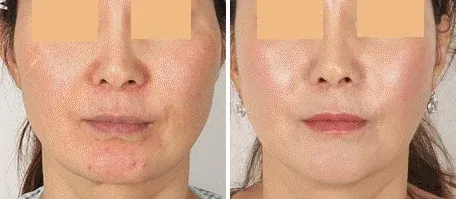
Face · Before Surgery → After Surgery
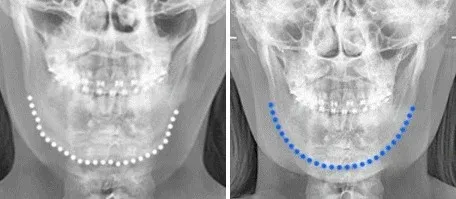
X-ray · Before Surgery → After Surgery
· Before surgery: A case in which only part of the Jaw Angle was resected, leaving the Face wide from the front and with a secondary angle after surgery / The patient underwent Jaw Angle surgery at another clinic, but the jawline was not smooth and a secondary angle developed. · After surgery: In the jaw revision surgery, the width of the jawbone was reduced, including the cortical bone, to achieve a frontal slimming effect. The previously formed secondary angle was smoothed with long-curve jaw reduction, and the uneven jawline was refined.
CASE 02. When the Jaw Angle reduction effect is insufficient after surgery, resulting in a less slender appearance
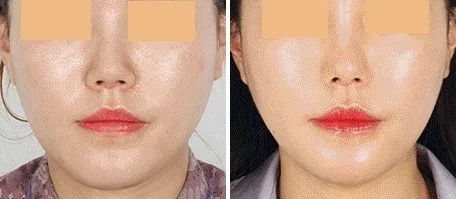
Face · Before Surgery → After Surgery
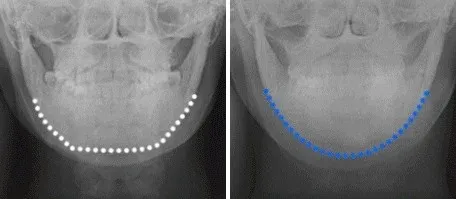
X-ray · Before Surgery → After Surgery
· Before surgery: The frontal slimming effect was insufficient after Jaw Angle surgery, and the chin still appeared blunt / The patient underwent Jaw Angle surgery at another clinic, but the Jaw Angle reduction effect was insufficient. · After surgery: Cortical bone was reduced through jaw reduction surgery to create a slimmer appearance from the front, and the chin was refined with chin surgery (T-osteotomy) / The jawline was refined with long-curve jaw reduction for a slimmer frontal appearance, and chin surgery completed the V-line.
CASE 03. When the frontal reduction effect is insufficient and the jawline is uneven even after surgery
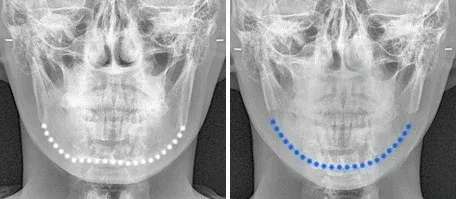
X-ray · Before Surgery → After Surgery
· Before surgery: The patient underwent Square Jaw Reduction, but the facial width was not significantly reduced from the front, resulting in an insufficient frontal facial reduction effect and an uneven jawline. · After surgery: The width of the lower jaw was reduced through cortical bone resection, and the mandibular body and chin line were refined to create a smooth, slender jawline.
CASE 04. When the jaw remains broad and asymmetrical after surgery
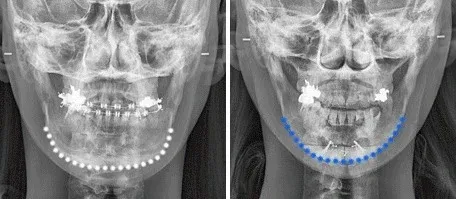
X-ray · Before Surgery → After Surgery
· Before surgery: The patient underwent Square Jaw Reduction, but the two sides of the jaw were asymmetrical in size and the jawline was not smooth. · After surgery: The jawline was smoothly refined with long-curve jaw reduction and chin surgery, improving it to be smaller, slimmer, and smoother.
CASE 05. When the chin appears longer after surgery
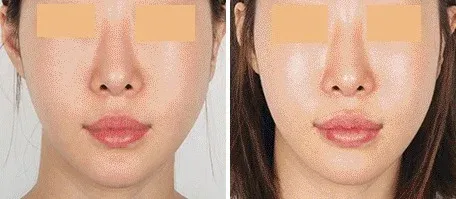
Front View · Before Surgery → After Surgery
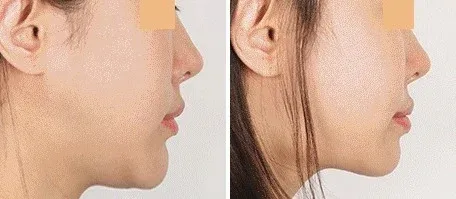
Side View · Before Surgery → After Surgery
· Before surgery: A case involving prior Jaw Angle surgery and chin surgery, after which the chin appeared long / The length was not improved in the previous chin surgery, and excessive advancement made the chin more prominent. · After surgery: Chin Reduction reduced the length of the chin, and long-curve jaw reduction smoothly refined the contour / Reducing the degree of chin advancement improved the previously prominent appearance of the chin.
CASE 06. When facial asymmetry becomes more severe after surgery
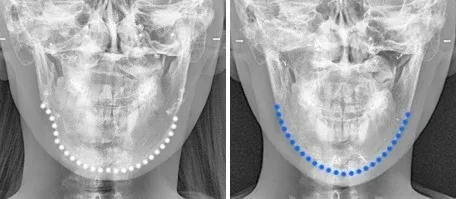
X-ray Front View · Before Surgery → After Surgery
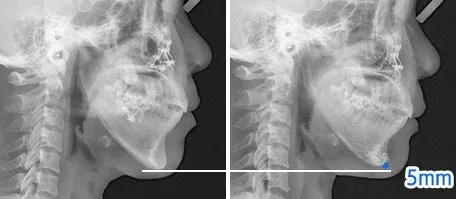
X-ray Side View · Before Surgery → After Surgery
· Before surgery: Facial asymmetry worsened and the chin became prominent after Orthognathic Surgery at another clinic / The chin remained long and prominent after Orthognathic Surgery. · After surgery: The jawline was refined to correct left-right asymmetry, and chin surgery (T-génioplasty + Chin Reduction) reduced the length and width of the anterior chin to create a V-line Face / Chin Reduction reduced the chin length by 5 mm, improving the prominent chin.
CASE 07. When the jawline is uneven and the chin becomes more prominent after surgery
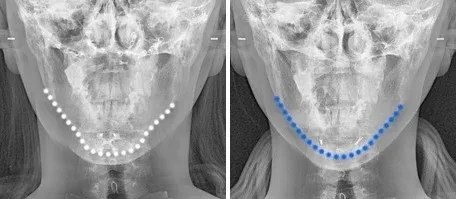
X-ray Front View · Before Surgery → After Surgery
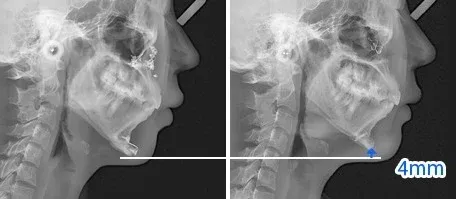
X-ray Side View · Before Surgery → After Surgery
· Before surgery: Surgery was performed without properly considering the jawline, resulting in an uneven jawline and an even more prominent chin / Excessive chin advancement made the chin appear long and prominent. · After surgery: The uneven jawline from the mandibular body to the chin was comprehensively smoothed, and the degree of chin advancement and jaw length were reduced for a more natural contour / The excessively advanced chin was appropriately moved back by 4 mm while reducing its length to improve the prominent chin.
Please Note
Bleeding, infection, inflammation, and other complications may occur after surgery, so caution is required. Subjective satisfaction may vary from person to person. Surgical methods and outcomes may differ depending on the individual's condition and are determined through consultation with a specialist.
 FACELINE PLASTIC SURGERY