
Non-Incisional Method
Price upon consultation
This procedure corrects drooping eyelids and sleepy-looking eyes by tying sutures through small openings without making skin incisions. It is indicated for mild to moderate ptosis, asymmetrical eyes, and cases in which the eyes appear smaller after double-eyelid surgery, among others, and uses a continuous multi-knot fixation technique. With minimal scarring and bleeding, it may be considered for those seeking a faster return to daily activities.
Surgery Overview
AI-generated information for reference only. Please consult a doctor for accurate, personalized advice.
Non-incisional method Ptosis Correction is a procedure that corrects drooping eyelids and sleepy-looking eyes by tying sutures through tiny holes without making an incision in the skin. It is effective for mild to moderate ptosis and asymmetrical eyes, and the continuous multi-knot power fixation technique is less likely to loosen than the Suture method, making it suitable for Revision surgery as well.

Large, defined eyes! With scar-free Non-incisional method Ptosis Correction, drooping, sleepy-looking eyelids and asymmetrical eyes can be made large, defined, and beautiful like doll eyes.
Recommended for the following people
· When more than one-third of the iris is covered by the eyelid, making the eyes look sleepy and tired · When there is a significant difference in size between the two eyes · When you frequently experience Headache or eye fatigue from using your eyebrows or Forehead muscles to open your eyes · When the crease looks unnatural and the eyes appear smaller after Double Eyelid Surgery · When you want a quick recovery and return to daily life
What is Faceline Non-incisional method Ptosis Correction?
Non-incisional method Ptosis Correction is a surgical technique that can correct the eye shape without an incision. It is effective for correcting mild to moderate ptosis when the goal is to increase the vertical length of the eyes for cosmetic purposes. Its greatest advantages are that daily activities can be resumed immediately after surgery and there is no need to worry about scars. It is also effective for asymmetrical eyes and is less likely to loosen than the Suture method, making it suitable for Revision surgery as well.
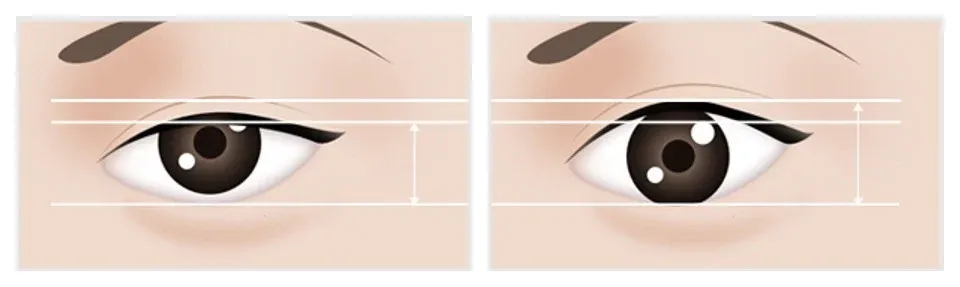
Before surgery: Sleepy-looking eyes → After surgery: Clear, refreshed-looking eyes
Features of Non-incisional method Ptosis Correction
Point 1. Just one day is enough! Short procedure time and quick recovery
Without making an incision, tiny holes are created in the skin and sutures are tied, making the procedure, operation time, and recovery period simple and quick while enabling natural Ptosis Correction without scars. This method corrects the eye shape through the conjunctiva without a skin incision. With just one day to spare, the entire process from surgery to recovery is possible. In addition, because it leaves no scars on the skin and causes minimal bleeding, recovery is quick, allowing you to achieve natural-looking doll eyes discreetly.
Point 2. Continuous multi-knot power fixation technique: helps prevent loosening!
At Faceline, we apply a continuous multi-knot power fixation technique to provide stronger fixation. To address the disadvantage of potentially loosening easily, we created fixation points that allow one additional knot compared with the fixation points used in the conventional Suture method. This helps reduce concerns about loosening.
Point 3. Large, defined, and natural doll-like eyes
Although fixation is achieved with continuous multiple knots, unlike the Incisional method, the results appear even more natural and beautiful. Faceline Non-incisional method Ptosis Correction applies personalized eye-shape correction based on extensive clinical experience. This allows for more natural and beautiful results.
Please be sure to check
Bleeding, infection, inflammation, and other complications may occur after surgery, so caution is required. Subjective satisfaction may vary from person to person. The surgical method and results may vary depending on the individual's condition and are determined through consultation with a specialist.
 FACELINE PLASTIC SURGERY