
Non-Incisional Method
from 400,000 KRW* VAT Not Included
For mild eyelid ptosis, this procedure corrects the strength of the muscle responsible for opening the eyes (levator palpebrae superioris) using sutures without a skin incision, increasing iris exposure and improving asymmetry between the two eyes. It is suitable for thin eyelids, leaves minimal visible scarring, and generally allows for a relatively quick recovery.
Surgery Overview
Non-incisional Ptosis Correction is a procedure that adjusts the length of the eyelid-opening muscle (levator palpebrae superioris) by creating knots with sutures, without making a skin incision. It aims to make sleepy-looking eyes appear more defined and correct asymmetrical eyes to match like a decalcomania, and is suitable for thin eyelids without severe drooping.

Make sleepy-looking eyes more defined and correct asymmetrical eyes to match like a decalcomania. When the muscle that lifts the eyelid (levator palpebrae superioris) weakens due to congenital factors or acquired aging, less of the iris is exposed, which can create a sleepy or tired-looking impression. In such cases, Double Eyelid Surgery alone has a high likelihood of loosening, and the eyes may still appear sleepy due to limited iris exposure. Opera therefore performs decalcomania Ptosis Correction, which adjusts the strength of the eyelid-opening muscle to increase iris exposure and improve asymmetry between the eyes.
Recommended for
· Those with thin eyelids without severe drooping · Those who want to create an In-Line Crease or maintain their existing eye shape · Those who want a quick recovery without concerns about scarring
Features of Opera Ptosis Correction
Point 1. Precise incision location and size
Even for severely drooping eyelids or thick eyes with excess fat, the incision location and size are precisely planned to reduce surgical marks and swelling.
Point 2. Correction of asymmetrical eyes
By adjusting the tension of the eyelid-opening muscles, symmetry between both eyes is balanced and corrected for a more harmonious appearance.
Point 3. Comfortable eye opening
For eyes that felt heavy and looked sleepy, Ptosis Correction creates lighter, more refreshed-looking eyes.
Point 4. Forehead wrinkle prevention
As the habit of opening the eyes using the Forehead muscles is corrected, it helps prevent additional Forehead wrinkles.
Ideal eye proportions
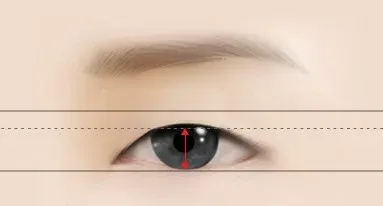
Eye with ptosis
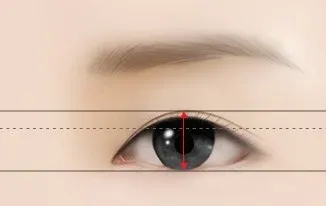
Normal eye
Clear, well-defined eyes are considered ideal when approximately 80–90% of the iris is exposed.
Ideal proportions for harmoniously symmetrical eyes
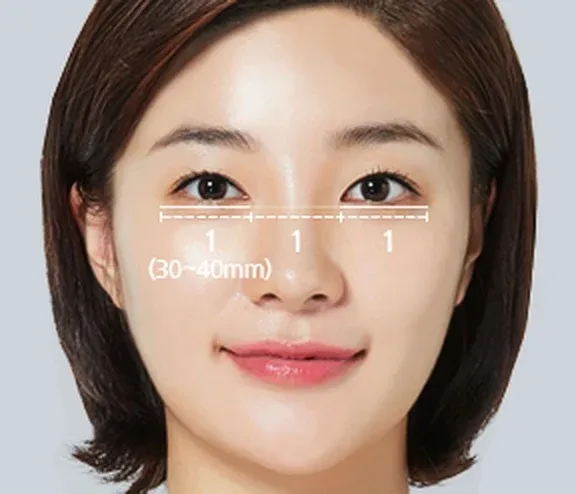
Horizontal eye length 1:1:1
The horizontal length of the eye is approximately 30–40 mm and forms a 1:1:1 ratio with the width between the eyes.
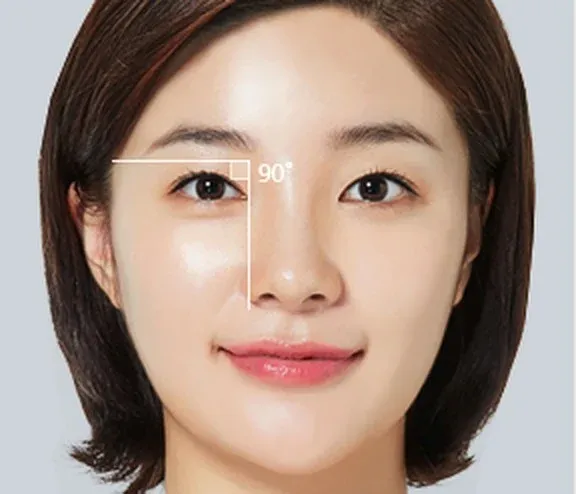
Eye position
Ideally, the eyes are positioned along a vertical line from the inner eyebrow to the nostril.
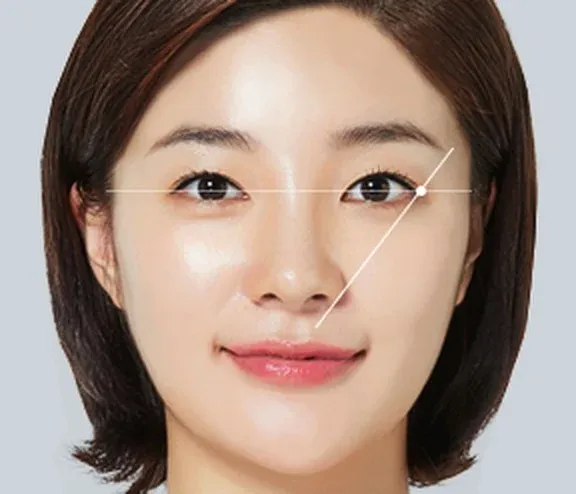
Outer eye corner and nostril
Ideally, the outer eye corner and nostril are connected in a straight line.
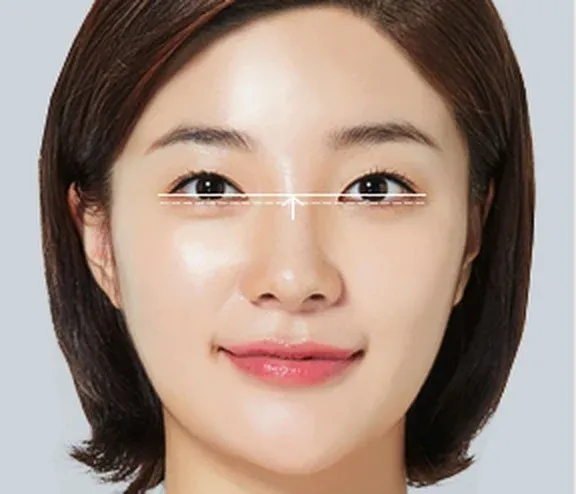
Outer eye corner height
Ideally, the outer eye corner is slightly higher than the horizontal line extending from the inner eye corner.
Non-incisional Ptosis Correction procedure
The tension of the eyelid-opening muscle is corrected without a skin incision. Fat removal is nearly impossible, but scars are barely visible and recovery tends to be quick.
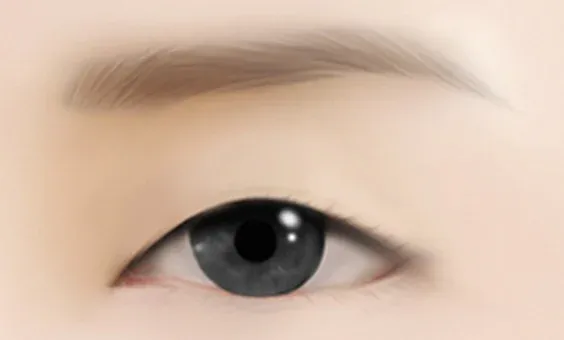
STEP 1. Before surgery
The degree of eyelid drooping and eyelid-opening strength are assessed to establish a correction plan.
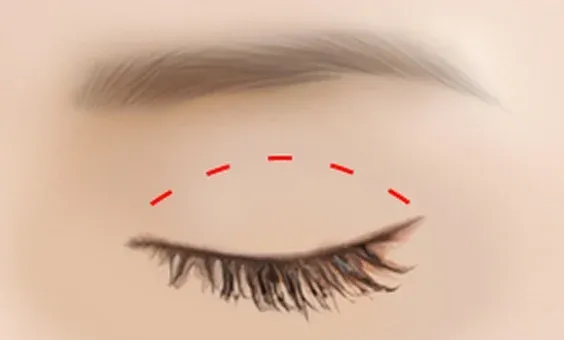
STEP 2. Create knots in the muscle
Sutures are used to create knots in the eyelid-opening muscle.
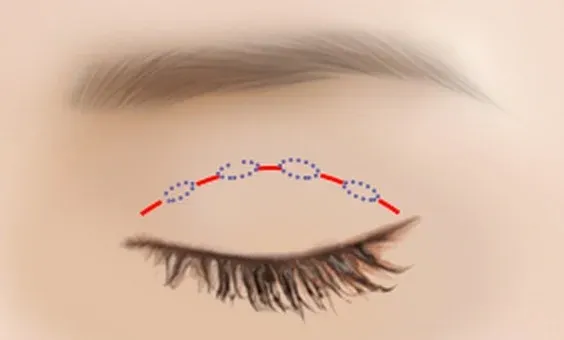
STEP 3. Adjust muscle length and create the crease
The knots are connected to adjust the length of the eyelid-opening muscle and strengthen its tension, while creating a natural double-eyelid crease on the inner side of the eyelid.
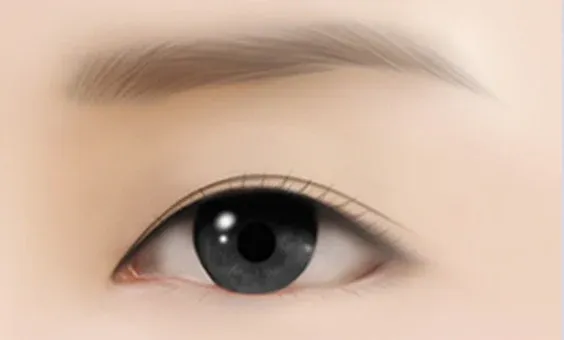
STEP 4. After surgery
Increased iris exposure creates more defined and refreshed-looking eyes.
For severe eyelid drooping with thick skin or excess fat, incisional Ptosis Correction may be considered.
Surgical Information
| Surgery time: Approximately 1 hour | Anesthesia: Local anesthesia after short-term sleep anesthesia | Suture removal: After 5–7 days | Follow-up visits: 1 visit | Recovery period: Daily activities are possible after suture removal
Pre- and Post-Operative Precautions
After surgery
· Swelling or bruising around the eyes may occur for 1–2 days after surgery and will gradually subside thereafter. · Apply cold compresses for approximately 6 days after surgery, then warm compresses to promote blood circulation. Place a thin towel over the eyes when applying compresses. · Face washing and makeup are permitted starting the day after suture removal. · It is recommended not to wear contact lenses for approximately 3 weeks. Wear glasses or sunglasses during this period. · Exercise other than light walking, as well as baths, jjimjilbangs, and saunas, are permitted after 3 weeks. A simple shower is possible starting the following day. · Avoid ultraviolet exposure for 3 weeks after surgery and wear sunglasses outdoors. · When sleeping, elevate your head with 2–3 pillows, and do not sleep on your side or stomach for approximately 4 weeks. · Take only the painkillers and antibiotics prescribed by the hospital. Avoid aspirin-based medications, as they may cause bleeding. · Alcohol and smoking are permitted after 3 weeks following surgery.
Please be sure to check
The surgical method and results may vary depending on the individual's condition and are determined through consultation with a specialist.
 OPERA PLASTIC SURGERY