Inverted Nipple
Price upon consultation
Corrects inverted nipples to improve appearance and, in some cases, nipple function.
Surgery Overview
AI-generated information for reference only. Please consult a doctor for accurate, personalized advice.
Inverted Nipple Surgery That Restores a Three-Dimensional Structure
This is not a procedure that simply pulls the nipple out—it supports the internal structure.
Inverted nipples are much more often caused by insufficient underlying support structures than by an issue with outward appearance.
Conceptual Cross-Sectional Side View
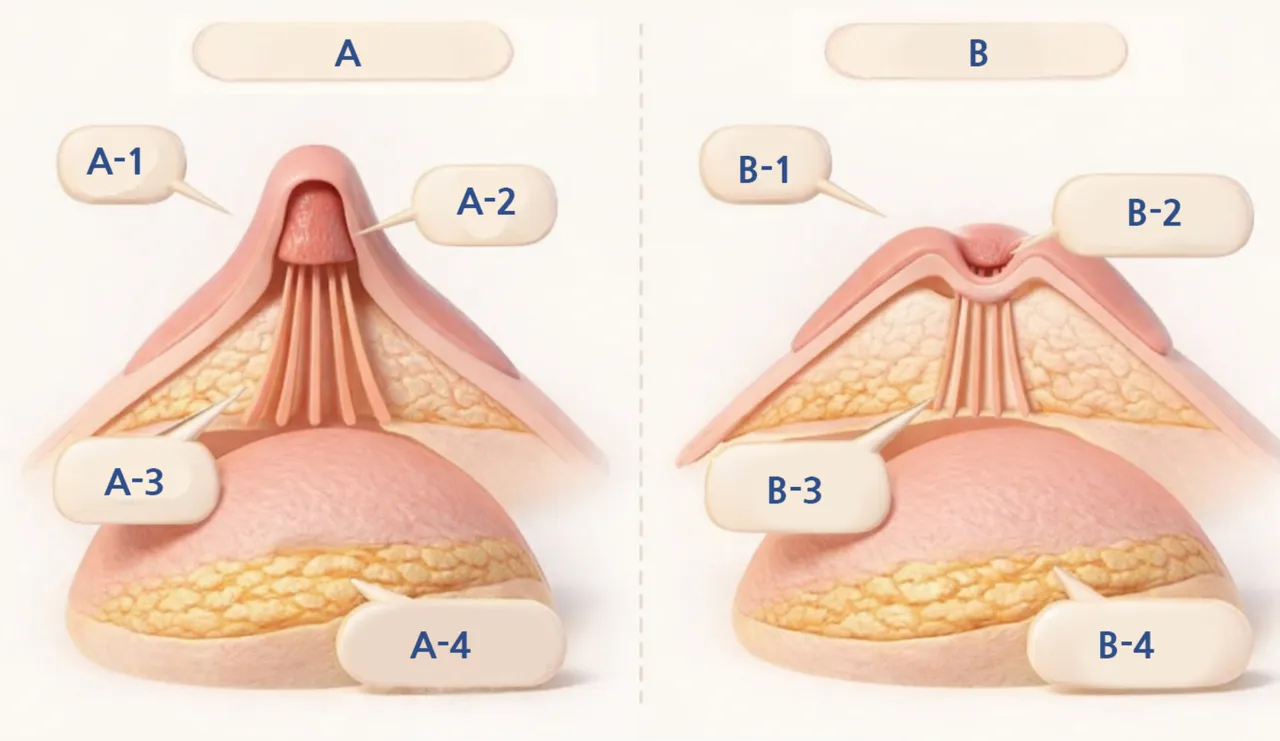
*A. Normal nipple structure / A-1. Skin / A-2. Nipple / A-3. Milk duct / A-4. Mammary tissue
**B. Structure of an inverted nipple / B-1. Skin / B-2. Short milk duct / B-3. Short milk duct / B-4. Mammary tissue
Left: Normal nipple structure, with well-developed skin, fibrous tissue, and milk ducts.
Right: Typical structure of an inverted nipple, in which the internal fibrous tissue and milk ducts are not fully developed.
From the outside, the nipple may appear to be a small projection slightly raised above the skin. Inside, however, it is a three-dimensional structure in which milk ducts, fibrous tissue, and supporting structures are interconnected.
If even one of these internal structures does not provide sufficient support, the nipple can naturally be drawn inward even at rest.
Therefore, Inverted Nipple correction should not be a procedure that forcibly “pulls out” the nipple from the outside; it should organize the internal structures and support the nipple so it can remain in its proper position.
From the outside, the nipple may appear to be a small projection slightly raised above the skin. Inside, however, it is a three-dimensional structure in which milk ducts, fibrous tissue, and supporting structures are interconnected.
If even one of these internal structures does not provide sufficient support, the nipple can naturally be drawn inward even at rest.
Therefore, Inverted Nipple correction should not be a procedure that forcibly “pulls out” the nipple from the outside; it should organize the internal structures and support the nipple so it can remain in its proper position.
Why Do Inverted Nipples Occur?
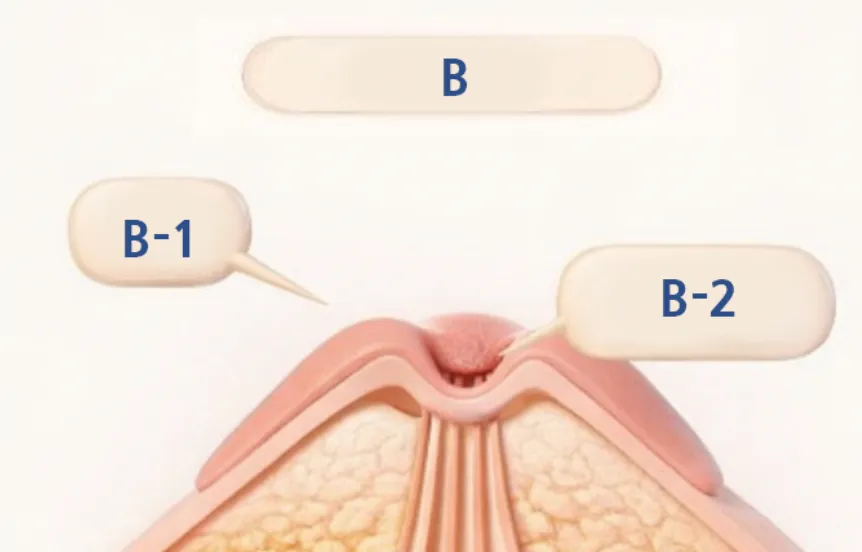
*B. Structure of an inverted nipple / B-1. Skin / B-2. Short milk duct
Although the severity varies from person to person, inverted nipples usually result from several structural factors working together rather than from a single cause.
First, the length of the milk ducts.
If the milk ducts are relatively short or remain under inward tension, the nipple is naturally subjected to a force that pulls it inward.
Second, traction from fibrous tissue.
When fibrous tissue beneath the nipple pulls tightly, the inward pulling force remains even if the nipple is pulled outward from the surface.
Third, the supporting structure beneath the nipple.
If the underlying foundation that supports the nipple is weak, it may temporarily protrude outward but often retracts again over time. Therefore, an inverted nipple is not simply an issue that can be solved by “pulling it outward”; it is a condition involving internal structures as well.
The Most Important Criterion When Determining the Surgical Method
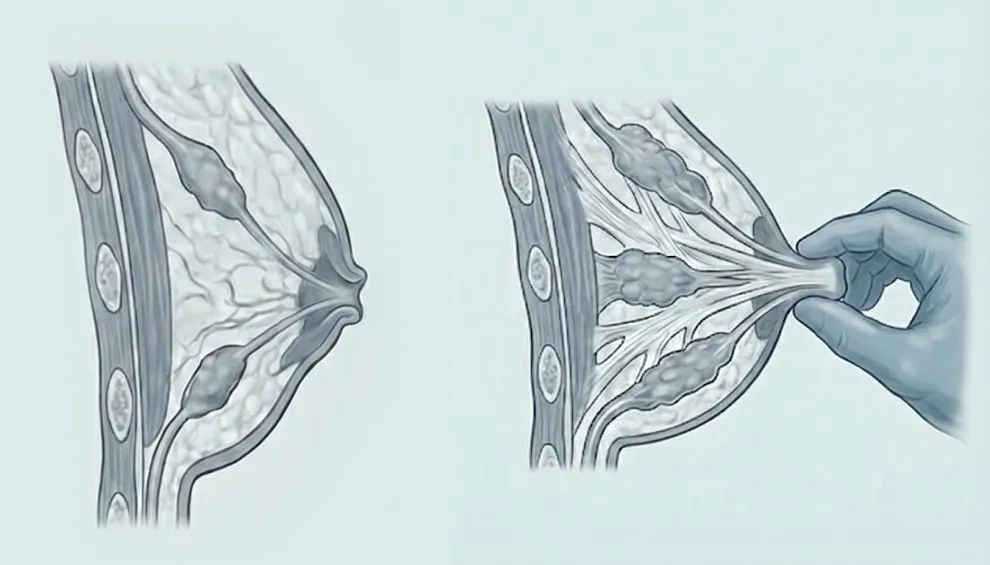
“To what extent can this nipple maintain its position on its own in its current condition?”
The scope and intensity of correction vary according to this criterion.
Cases That Can Be Maintained With Relatively Mild Correction
Non-incisional method Inverted Nipple Surgery Overview
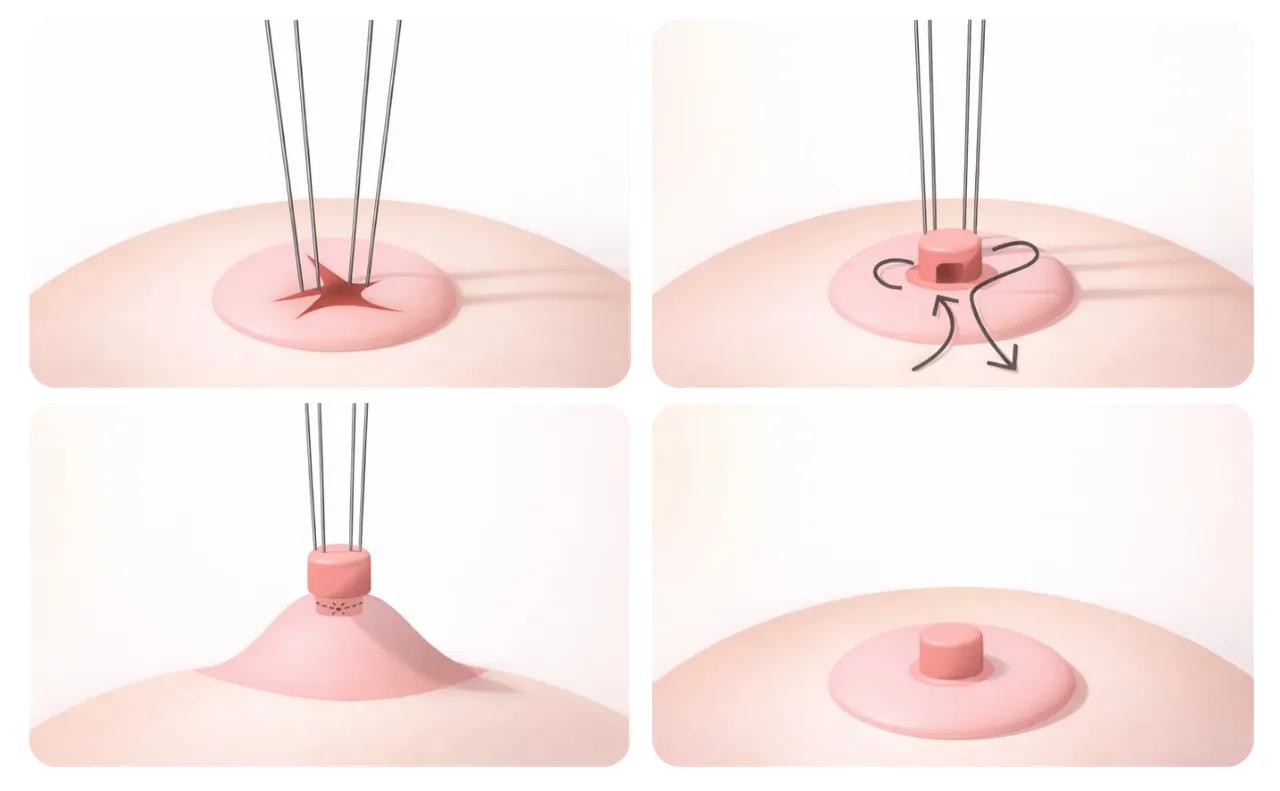
In some cases, when the nipple is gently pulled during consultation, it protrudes naturally and remains out for a relatively long time even after the hand is released.
In such cases, the inward pulling force is considered to be limited, and some of the nipple's supporting structure is likely still intact. Particularly for those planning Breastfeeding in the future or wishing to reduce the burden of recovery, relatively mild correction that minimizes tissue damage may be sufficient to maintain the result.
However, this cannot be determined based on outward appearance alone; it can only be discussed after the internal structure has been directly assessed during the preoperative consultation.
Cases Requiring Detailed Structural Correction
Conversely, in some cases the nipple does not protrude easily even when pulled manually, or it protrudes only briefly before quickly retracting. In such cases, the inward pulling force is likely relatively strong.
If only methods that tie or secure the nipple externally are selected in this condition, the initial result may appear satisfactory, but retraction over time is not uncommon.
In addition, repeated correction may cause Adhesion in the internal tissues and place stress on blood circulation, making subsequent correction more difficult.
Therefore, in these cases, rather than an approach that only changes the outward appearance, correction is needed to organize the internal structures and provide fundamental support to prevent the nipple from retracting again.
Inverted Nipple Correction Using an Incisional Method
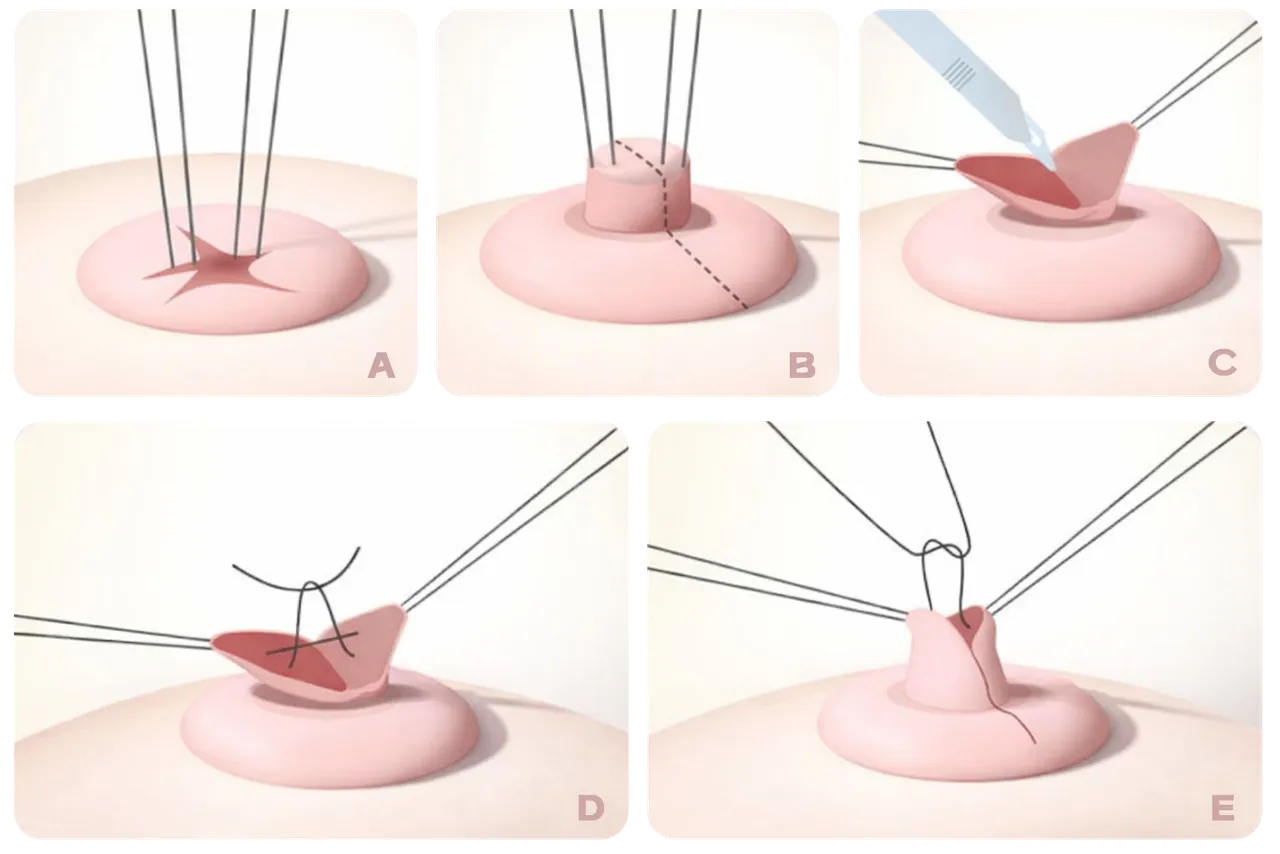
Which Method Should You Choose?
If You Want Reliable Correction Without Recurrence
Because inverted nipples involve congenitally insufficient tissue, it is better to consider a procedure with reliable corrective results from the beginning rather than seeking only a simple procedure. Repeated surgeries can cause tissue atrophy and reduced blood circulation, so choosing a procedure with a high likelihood of success in one operation is more reasonable.
When Considering Breastfeeding
If preserving the possibility of Breastfeeding is the highest priority, the Non-incisional method may be considered first. However, the key factor is whether the nipple can be gently pulled and fully brought outward. For severe inverted nipples, the likelihood of recurrence is high; therefore, considering the Incisional method after childbirth is advisable.
When Considering Surgery for Cosmetic Reasons
If addressing an aesthetic concern is the primary goal, the Incisional method can be a good option. However, if you plan to Breastfeed in the future, it is advisable to discuss this thoroughly with a specialist before surgery.
Moms Surgery Inverted Nipple FAQ
A. Inverted nipples can occur when the milk ducts or fibrous tissue are congenitally short, and, in rare cases, may also result from acquired causes such as inflammation or trauma. It is advisable to consult a medical professional to determine the exact cause.
A. Not all inverted nipples necessarily require surgery. However, treatment may be considered if hygiene management is difficult, there is recurrent inflammation, difficulty with Breastfeeding, or concerns about appearance.
A. This varies depending on the degree of inversion and the surgical method, and recurrence is possible in some cases. It is important to establish a surgical plan that fully takes the individual’s condition into account.
A. The effect on Breastfeeding may vary depending on the surgical method. If you are planning a future pregnancy or childbirth, inform the medical team in advance during your consultation so that an appropriate surgical method can be selected.
A. In many cases, the incision is not extensive, so scars tend to be relatively inconspicuous. However, skin characteristics and the healing process vary by individual, so thorough postoperative care is important.
A. In most cases, daily activities can be resumed relatively quickly, but it is advisable to follow the medical team’s instructions until the wound area has stabilized. Recovery speed may vary from person to person.
A. Yes. If only one side is inverted, correction can be performed only on that side, and the surgical plan will take bilateral balance and shape into consideration.
A. Depending on the individual nipple shape and size, Inverted Nipple correction and Areola Reduction may be performed together. After accurately assessing the current condition through consultation, an appropriate surgical method is determined.
Although Inverted Nipple surgery may appear minor externally, it is not a procedure that should be decided on lightly.
What matters is not “which method seems easier,” but how long and how reliably the result can be maintained.
Making the safest choice with the least strain based on that standard—that is the key to Inverted Nipple correction without recurrence.
 MAMMS Clinic