
Forehead Reduction Surgery
from 2,200,000 KRW* VAT Not Included
This procedure involves making an incision along the hairline, dissecting and advancing the scalp forward, and excising overlapping forehead skin to reduce forehead length. An oblique incision that considers the direction of hair growth and follicle-preservation techniques are used to minimize hair follicle damage, and the scalp is secured with absorbable fixation pins. Depending on individual facial proportions and scalp elasticity, the forehead can be reduced by approximately 1–3 cm.
Procedure Overview
Forehead Reduction Surgery involves making a delicate incision along the hairline, pulling and securing the scalp, and removing overlapping forehead skin to reduce forehead length by 1–3 cm. M-shaped or squared hairlines and asymmetry can also be corrected, making the face appear smaller and creating a more refined impression.

Hairline correction along with forehead reduction Reduces a wide forehead to suit overall facial balance, creating a rounded forehead contour from the side and well-proportioned balance from the front.
Recommended for
· Those whose face appears long due to a wide forehead · Those with an M-shaped forehead line · Those with a squared, angular forehead line · Those with an asymmetrical forehead line · Those whose forehead appears wider due to sparse hair along the hairline
Before-and-after photos
A smaller-looking face, a natural hairline

Before → After
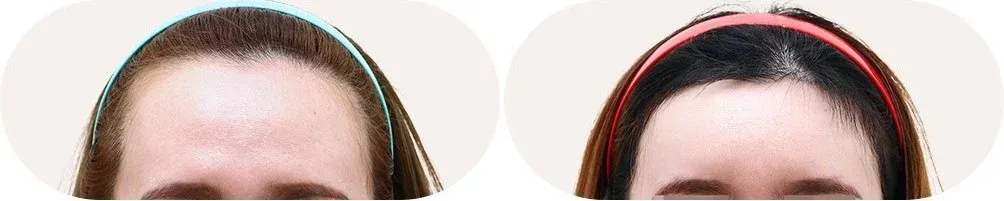
Before → After

Before → After

Before → After

Before → After
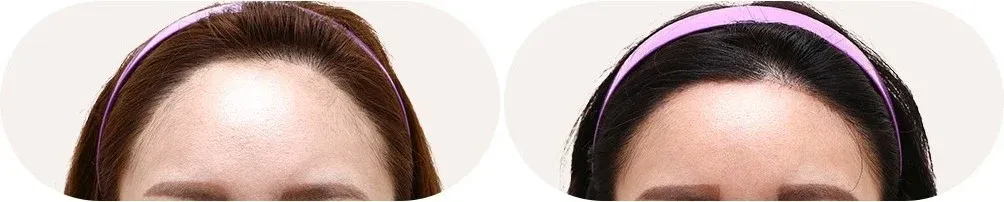
Before → After
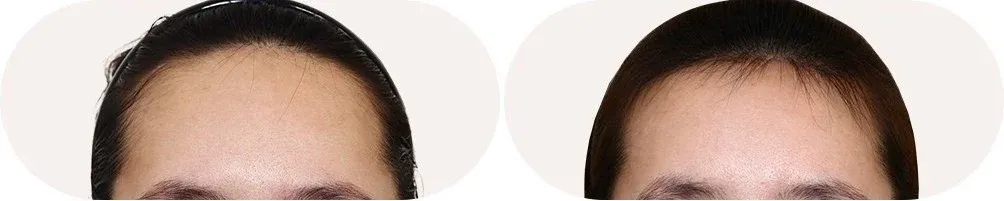
Before → After
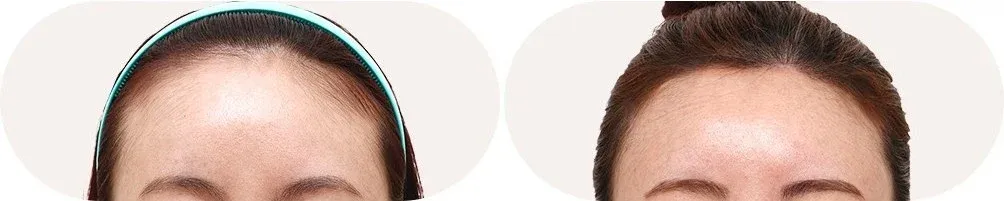
Before → After
Features of Wonjin Forehead Reduction Surgery
Point 1. Ideal forehead length suited to facial contours
The forehead length is determined according to overall facial proportions.
Point 2. Natural hairline
The hairline is designed naturally.
Point 3. Minimal incision for minimized scarring
The incision is kept to a minimum along the hairline to reduce scarring.
Point 4. A smaller-looking, more youthful face
Reducing forehead length makes the face appear smaller and younger.
Point 5. Minimized hair root damage
Hair root damage is minimized through follicle-preserving techniques.
Research and experience in Forehead Reduction Surgery

Wonjin Plastic Surgery educates and shares expertise on Forehead Reduction Surgery methods and techniques. · Publication of the Forehead Reduction Plastic Surgery TRM Reports report · Publication of a paper on Forehead Reduction Surgery using fixation pins – AAPS (Archives of Aesthetic Plastic Surgery)
What makes Wonjin Forehead Reduction Surgery special
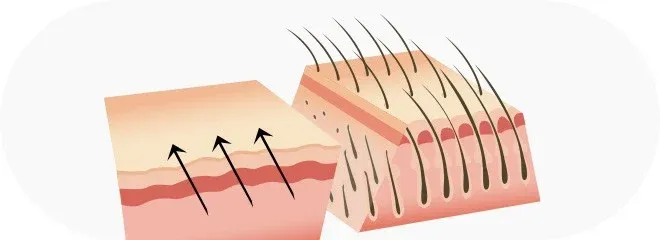
01. Follicle-preserving incision
The incision is made diagonally in consideration of the direction of hair growth, resulting in very little hair root damage. Surgical traces are less noticeable, and fine forehead hairs are appropriately preserved to create a natural hairline.
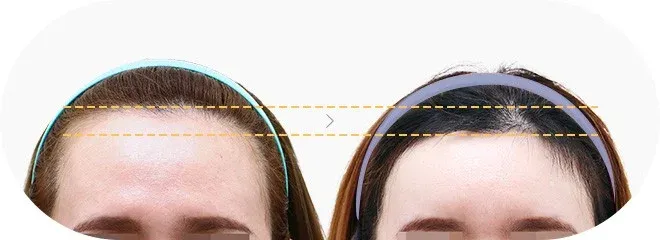
02. Forehead length reduction of up to 3 cm
Rather than reducing it indiscriminately, the forehead is reduced by approximately 1–3 cm according to overall facial proportions and scalp elasticity. Surgical traces gradually fade over 1–6 months.
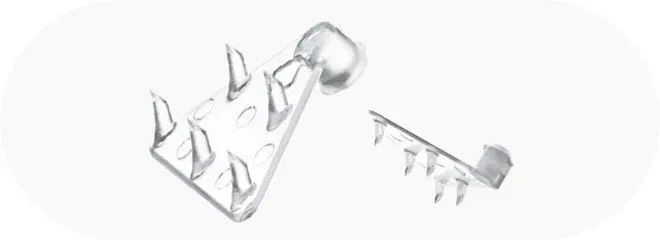
03. Secure fixation with fixation pins
Fixation pins can expand the surgical range by an additional 0.3–0.5 cm and provide stronger secondary fixation to prevent widening after surgery. The pins are absorbed by the body after 6 months, reducing the burden of foreign-body sensation and inflammation while also lowering scalp tension.
Surgical procedure
An incision is made in consideration of the direction of hair growth. The scalp is sufficiently dissected and pulled forward, overlapping forehead skin is removed, and special suturing is performed. Follicle-preserving techniques are also used to protect the hair roots and hair.
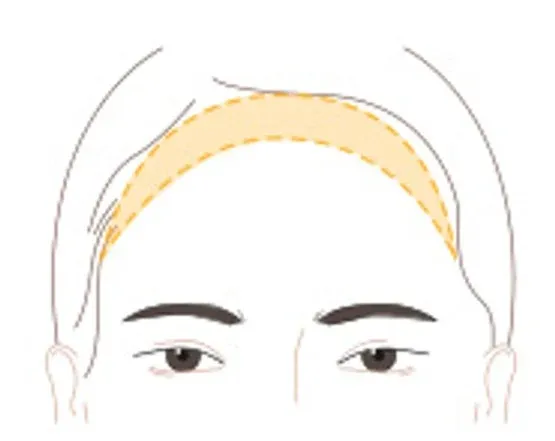
STEP 1. Check the incision site
The surgical area is designed according to ideal forehead proportions.
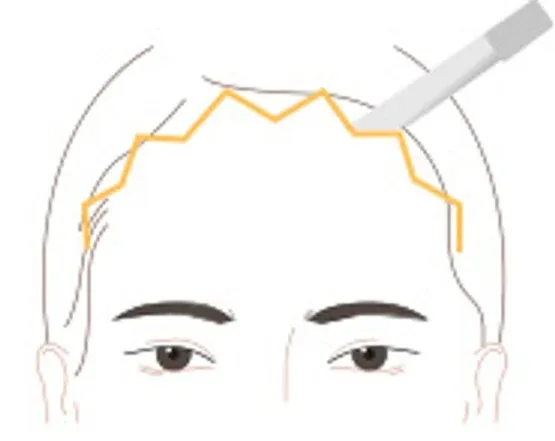
STEP 2. Hairline incision
The hairline is delicately incised in consideration of the direction of hair growth.
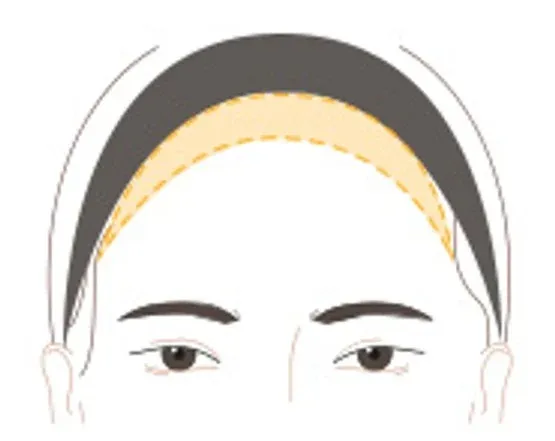
STEP 3. Forehead skin removal
After dissecting the scalp using an Endoscope, a predetermined amount of forehead skin is removed.
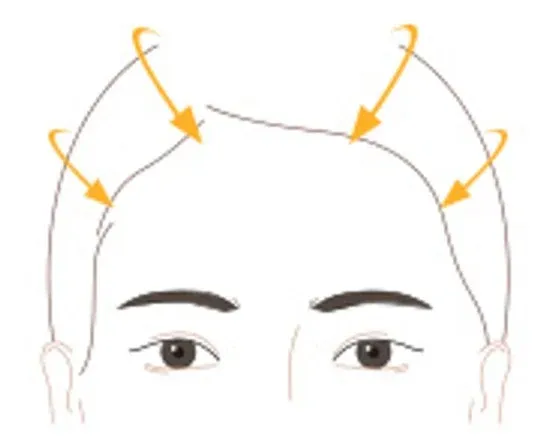
STEP 4. Fixation pin placement
The scalp is pulled forward and secured with fixation pins, followed by special suturing.
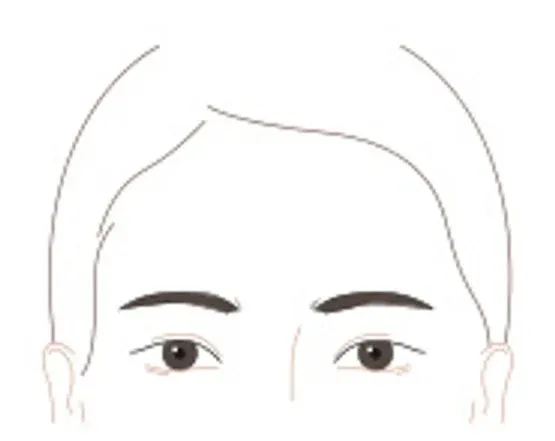
STEP 5. Postoperative changes
An ideal forehead and natural hairline can be seen.
Surgery information
| Surgery duration: 2 hours | Anesthesia: Sedation anesthesia | Hospitalization: Same-day discharge | Suture removal: After 7 days | Return to daily activities: Possible after 3 days
Please note
Complications that may generally occur after surgery or treatment, including bleeding, infection, inflammation, and nerve damage, may vary in severity from person to person and require caution. Surgical methods and results may vary depending on the individual's condition and are determined through consultation with a specialist.
 WJ WONJIN PLASTIC SURGERY