
Facelift
from 5,333,000 KRW* VAT Not Included
The Difference in Depth That Turns Back Time: Roy Facelift

Facelift
The difference in depth that turns back time
The most reliable way to improve sagging skin and a weakened facial contour caused by aging is a Facelift. Roy Plastic Surgery does not simply pull the surface of the skin; we use an extended deep-plane Facelift technique that addresses the underlying causes of sagging, delivering natural yet powerful Lifting results.
1. Roy Plastic Surgery's Core Technique: What Is the Deep Plane?
The key to a Facelift lies in how the SMAS, a thin fascial layer beneath the skin, is handled. The deep plane refers to the layer directly beneath the SMAS. Roy Plastic Surgery performs Lifting by precisely dissecting this deep layer.
Why Is Deep-Plane Dissection Important?
• Safety
The deep-plane layer is a very safe space where major nerves and large blood vessels do not pass.
• Minimal Bleeding and Faster Recovery
Because it is a nearly avascular plane, there is minimal bleeding during surgery, resulting in less bruising and swelling and a faster recovery.
2. The Key to a Successful Facelift: Tension-Free Lifting
Skin tissue is firmly anchored to deep structures by multiple retaining ligaments. Without addressing this resistance, satisfactory Lifting results cannot be achieved. Only by sufficiently releasing all resistance holding the skin beneath the SMAS can the tissue be lifted naturally and attractively.
✦ The Main Cause of Scarring: Excessive Skin Pulling
The main reason many Facelifts fail or leave severe scars is that only the skin is pulled excessively without eliminating resistance in these deep layers.
If the skin is forcibly pulled tightly and sutured, excessive tension creates a force that pulls it back to its original position. This force can continuously pull the sutured area apart, causing the scar to become wider and more pronounced.
✦ Roy Plastic Surgery's Approach
Deep-plane Dissection sufficiently releases resistance. With no resistance, the tissue lifts easily without needing to be pulled tightly.
✓ Maximized Results: Excessive tension is not placed on the skin, minimizing scars and maximizing the Lifting effect.
✓ Minimized Swelling: Dissection of the layer directly beneath the skin (subcutaneous layer) is minimized, and swelling is reduced through internal compression using other tissues during surgery.
3. Finding the Optimal Lifting Direction (Vector)
Each person has a different facial shape and degree and direction of sagging. Therefore, the direction of pulling (vector) is highly important to surgical outcomes.
Roy Plastic Surgery does not pull in a uniform direction. During surgery, we assess multiple points by pulling in various directions to identify the most effective and aesthetically pleasing direction for each patient and perform customized Lifting.
4. Surgical Information
Facelift Incision Lines
Incisions are made within the hairline and along the ear's natural anatomical contours, then meticulously sutured to make scars as inconspicuous as possible.
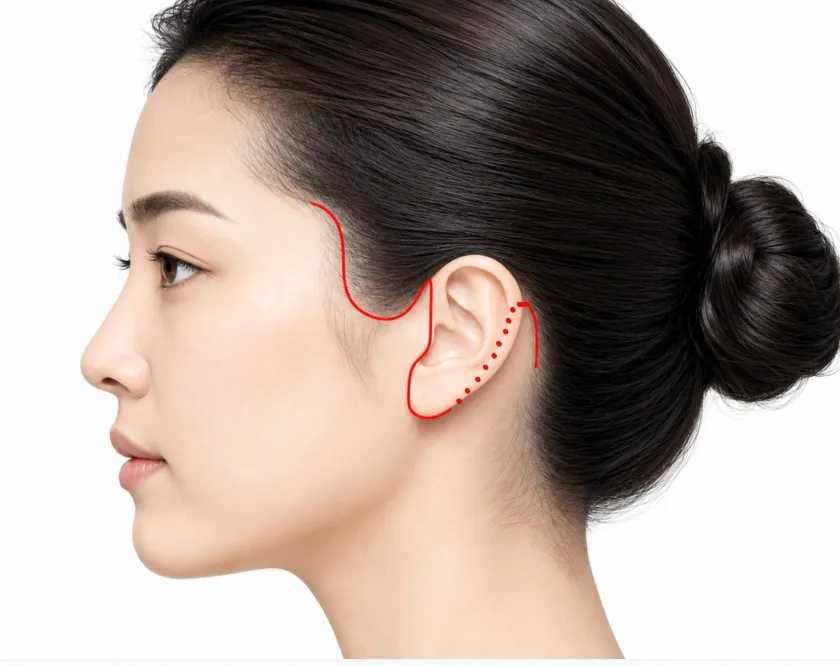
Solid line: Incision lines at the temple, in front of the ear, and beneath the chin • Dashed line: Incision within the hairline behind the ear
Difference Between a Facelift and Neck Lift
The area below the jawline (a double chin and loose neck skin) is, strictly speaking, not part of a Facelift but rather a Neck lift.
• For younger patients without sagging below the jawline, a Neck lift may not be necessary.
• However, many people have few opportunities to closely examine their profile and may not recognize the extent of their double chin or jawline sagging.
To improve satisfaction with a Facelift, the decision on whether to combine it with a Neck lift is best made through an accurate consultation with a specialist.
5. Recovery Process Guide
The recovery period may vary depending on each individual's health condition and constitution.
D+1 / Postoperative Day 1
You must visit the clinic for wound care. At this time, the need for additional visits on postoperative days 2 and 3 will be determined based on your condition. If recovery is progressing well, you may perform self-care at home and return for suture removal.
D+12 / Postoperative Day 12
All sutures are removed. If a Neck lift was performed at the same time, sutures at the incision beneath the chin are removed first on day 7.
Swelling / Swelling Progress
For healthy individuals without significant underlying conditions, the characteristics of the deep-plane technique mean that most major swelling has subsided by day 12, and swelling is often less severe than expected.
Final / Final Results
By around 1 month after surgery, results often look natural without obvious signs of surgery. Residual swelling then gradually subsides and the results continue to settle more beautifully; depending on the individual, complete settling may take 6 months or longer.
Note: Bruising, swelling, and sensory changes vary by individual. A return-to-work and daily-life plan tailored to your occupation and lifestyle will be discussed in detail during consultation.
Before-and-After Photos
※ This material is medical information published with the patient's written consent (Article 56 of the Medical Service Act).
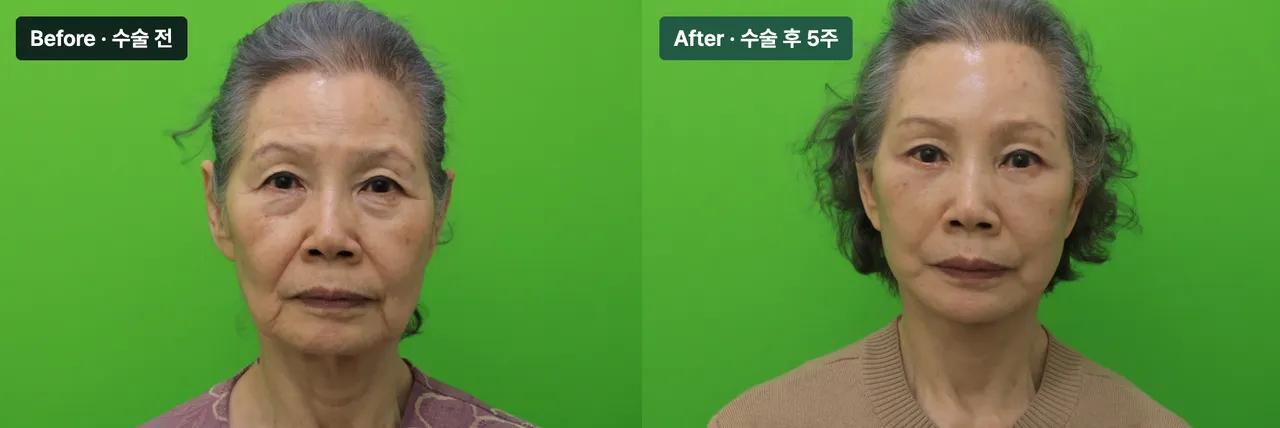
Case #1
81-year-old woman • Facelift + Neck lift + Endoscopic brow lift + Lower eyelid surgery (comprehensive anti-aging) / Photo taken: 5 weeks after surgery
| Procedure Details
Facelift + Neck lift + Endoscopic brow lift + Lower eyelid surgery (four procedures performed simultaneously; comprehensive anti-aging)
※ Recovery stage guide: At 5 weeks, recovery is still in an intermediate stage, and swelling or minor bruising may remain. Final results settle naturally over 6 months or more after surgery and vary by individual.
⚠︎ Side Effects and Precautions (Please review carefully)
• Possible side effects: swelling, bruising, temporary reduced or altered sensation, incision scars, and temporary hair changes due to follicular damage
• In rare cases, temporary facial nerve weakness (which almost always recovers), hematoma, infection, or incision wound dehiscence may occur.
• Recovery may be somewhat slower in older patients, and recovery patterns vary depending on overall health.
• Recovery timeline: Average return to daily activities is 2–3 weeks; natural results settle in 3–6 months. Combined procedures require a longer recovery period than a single procedure.
• Surgical results may vary depending on skin elasticity, bone structure, degree of aging, and lifestyle habits.
• These photos were published with the patient's consent without mosaic masking. Unauthorized copying or redistribution on social media is prohibited.
 ROI PLASTIC SURGERY