
Contracted Nose Reconstruction
from 500,000 KRW* VAT Not Included
In cases where the nose has become shortened and deformed due to inflammation or contracture caused by synthetic implants, this is a revision procedure that reconstructs the nose without synthetic implants, using autologous costal cartilage and temporal fascia. The procedure uses an autologous implant made by crushing costal cartilage and wrapping it in fascia, with the aim of reducing concerns regarding in-body absorption and visibility through the skin.
Implant-free contracture rhinoplasty is a Rhinoplasty Revision procedure that reconstructs a nose affected by inflammation and contracture caused by artificial implants, using Autologous Rib Cartilage and temporalis fascia without artificial implants. It uses an autologous implant made by crushing Rib Cartilage and wrapping it in temporalis fascia to reduce warping and foreign-body sensation, correcting both the internal nasal support structure and the external appearance.

Safely reset with an autologous implant instead of an artificial implant, addressing everything from the damaged internal nasal support structure to the external appearance at the same time. For those who have already undergone rhinoplasty multiple times and are too afraid to undergo another revision, Opera implant-free contracture rhinoplasty aims to erase the traces of unsuccessful surgery.
Recommended for
· Those with inflammation caused by artificial implants, Crooked Nose, spherical contracture, or visible Silicone implant · Those with complex issues involving the support structure, Cartilage, and skin due to multiple Rhinoplasty Revision procedures · Those who underwent surgery using only a Dermal Graft but did not achieve the desired contour due to absorption by the body
Why does nasal contracture occur?
01. Inflammation caused by a rejection reaction
The use of artificial materials such as Silicone implant, Gore-Tex, and Medpor may be advantageous cosmetically, but if they are not compatible with an individual's constitution, a rejection reaction may cause inflammation.
02. Missing the appropriate timing for Revision surgery
If inflammation is not properly managed in a timely manner, the skin may contract and scar tissue may form, causing deformity, contracture, and pain.
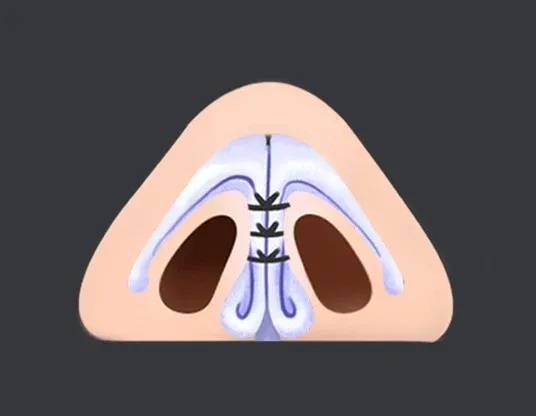
Those who have undergone multiple Rhinoplasty Revision procedures often have a variety of complex issues, from the internal nasal support structure to the outer Cartilage and skin. To correct damage to the support structure and the disrupted underlying structure, it is important to accurately examine the inside of the nose and correct the support structure properly and securely first. In particular, because contracture noses often develop inflammation and contracture due to artificial implants, it is advisable to proceed without an implant to prevent rejection.
After implant-free contracture rhinoplasty
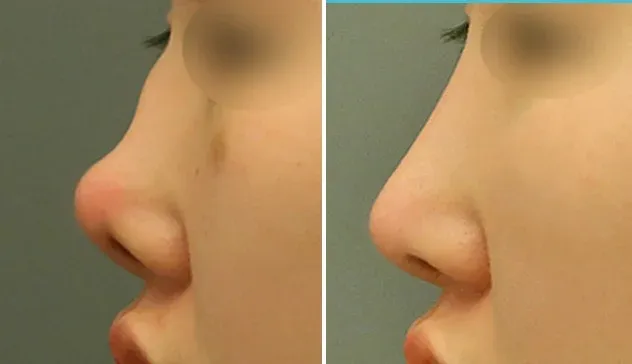
Before surgery → 6 months after surgery ※ Results may vary by individual, and side effects such as inflammation, bleeding, and nerve damage may occur; caution is required.
Autologous materials for implant-free contracture rhinoplasty

Temporalis fascia
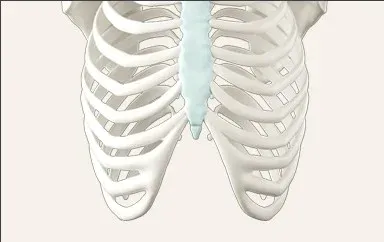
The most commonly used material for Rhinoplasty Revision: Rib Cartilage
Advantages · Relatively sturdy compared with other types of Cartilage · A relatively large amount can be harvested · Relatively low risk of inflammation and immune reactions · Advantageous for building up the nose with stronger support Disadvantages · May feel unnatural and hard · When surgery is performed using only Rib Cartilage, there is a relatively high chance of absorption by the body
Using whole Rib Cartilage vs. crushed Rib Cartilage
· When used whole: The Nasal Bridge may become warped or hard, and there may be concerns about an unnatural contour and visibility after 1–2 years. · When used crushed: There is a lower likelihood of Nasal Bridge warping and almost no foreign-body sensation. It provides a natural contour with less concern about visibility, helping reduce Revision surgery due to absorption.
Surgical procedure for autologous implant contracture Rhinoplasty Revision
Because autologous implant nasal reconstruction requires more effort and time for crushing, the procedure is performed directly by an experienced, skilled specialist.
STEP 1. Rib Cartilage harvesting
An approximately 2 cm incision is made along the inframammary fold to harvest Rib Cartilage.

STEP 2. Temporalis fascia harvesting
A portion of the fascia in the temporal region (the Temple above the ear) is incised.
STEP 3. Rib Cartilage crushing
The harvested Rib Cartilage is evenly crushed.
STEP 4. Preparing Rib Cartilage particles
Rib Cartilage particles are placed inside the harvested temporalis fascia.
STEP 5. Shaping into an implant
The Rib Cartilage particles are wrapped in fascia and shaped into an Implant form.
STEP 6. Insertion of Rib Cartilage particles
After shaping the nasal contour, the Rib Cartilage particles are injected into the nose.
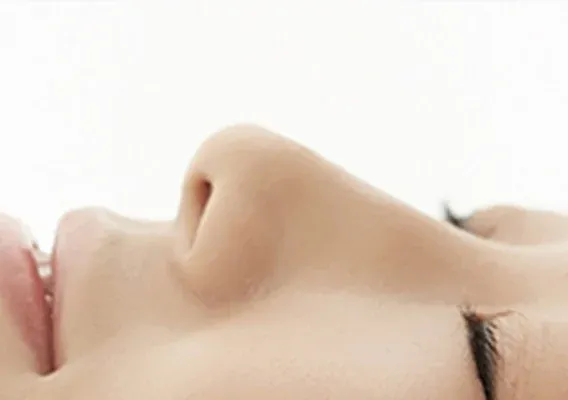
STEP 7. Final step (surgery complete)
The inserted autologous implant gradually integrates with the skin.
Why temporalis fascia is used
When a special solution is used to harden Rib Cartilage particles, there is concern that bone particles may become visible and harden over time. To prevent this, Opera performs the procedure using temporalis fascia.
Advantages of autologous implant nasal reconstruction surgery
· Engrafted Dermal Graft can be maintained for a long time · Reduces concerns about side effects such as inflammation and contracture · Improves the nose with a natural contour · Relatively little foreign-body sensation
Could I need another Revision surgery?
If inflammation occurs, do I need another Revision surgery?
Because Opera implant-free Rhinoplasty Revision is performed using Autologous Tissue without artificial implants, even if inflammation occurs, it can be adequately treated with medication.
If my nose becomes crooked again, do I need another Revision surgery?
If the shape of the nose changes, it can be improved using Autologous Fat alone without complex Revision surgery.
Pre- and post-operative precautions
After surgery
· Swelling or bruising around the eyes may occur for 1–2 days after surgery, and slight bleeding or discharge may be visible for about 2–3 days. · Cold compresses are recommended for about 7 days after surgery, followed by warm compresses. Apply compresses near the base of the nose and around the eyes, and avoid the Nasal Bridge and Nasal Tip. · You may wash your face and apply makeup starting the day after suture removal. · Do not remove the tape or splint on the nose, or the cotton placed inside the nose, on your own. · Do not blow your nose for about 2 weeks after surgery. Sneeze with your mouth open. · Exercise other than light walking, as well as baths, jjimjilbangs, and saunas, may be resumed 3 weeks after surgery. · When sleeping, elevate your head with 2–3 pillows, and avoid sleeping on your side or face down for about 4 weeks. · Take only the painkillers and antibiotics prescribed by the hospital, and avoid aspirin-based medications. · Alcohol and smoking may be resumed 3 weeks after surgery. Wear glasses or sunglasses after 3 weeks (or after 1 month in the case of Genioplasty).
Please be sure to check
Results may vary by individual, and side effects such as inflammation, bleeding, and nerve damage may occur; caution is required. The surgical method is determined through consultation with a specialist.
 OPERA PLASTIC SURGERY