
Breast Reduction
from 1,500,000 KRW* VAT Not Included
For excessively large breasts relative to the body, causing neck, shoulder, or back pain, dermatitis, or similar symptoms, this procedure reduces breast volume using the most appropriate method—periareolar, vertical, inverted-T incision, or liposuction breast reduction—based on a comprehensive assessment of breast volume, anatomical structure, and skin condition. It is performed under general anesthesia and takes approximately 2–3 hours.
Surgery Overview
Breast Reduction is a procedure that corrects the volume of excessively large breasts relative to the body into a size suited to the body frame and an attractive shape. Depending on the degree of enlargement and ptosis, as well as the proportion of mammary and fatty tissue, the appropriate method is selected among periareolar, vertical, inverted-T incisional methods, or liposuction Breast Reduction.

It corrects the volume of excessively large breasts that cause discomfort and stress in daily life into a size suited to the body frame and an attractive shape.
Recommended for the Following
· Those experiencing psychological stress due to large breasts · Those with discomfort from neck, shoulder, or Lower Back Pain and disc problems · Those who have developed dermatitis or Eczema beneath the breasts, pigmentation, or scarring · Those with severe Breast ptosis
What problems can be caused by macromastia?
Unlike in the past, macromastia is also increasing in Korea, primarily due to Westernized dietary habits. Generally, the ideal breast volume is about 250–300 cc, and volumes of 400 cc or more may be classified as macromastia. Excessively large breasts relative to the body can cause neck, shoulder, and Lower Back Pain and discomfort, in addition to psychological stress. In cases of severe breast sagging, the inframammary fold may press against the skin and reduce ventilation, leading to dermatitis, Eczema, pigmentation, scar formation, and other issues.
Macromastia Self-Assessment
Whether surgery is needed for macromastia is determined by comprehensively assessing the difference between the upper and lower breast, volume, individual body proportions, and daily-life discomfort. · Upper-to-lower breast difference of 10 cm: B cup · 15 cm: C cup · 17.5 cm: D cup · 20 cm: E cup · 22.5 cm: F cup · 25 cm: G cup
Breast Reduction Surgical Methods
Based on a detailed assessment, breast volume, anatomical structure, skin, and Soft Tissue are evaluated comprehensively to determine the surgical method most appropriate for the ideal breast shape.
CASE 1. Mild breast hypertrophy: Periareolar incisional method
This method is suitable when the breasts are not excessively large and ptosis is not severe. Although the reduction amount is limited, only the circumference of the areola is incised and tissue is removed through it, resulting in a natural shape with minimally noticeable scars.
CASE 2. Moderate breast hypertrophy: Vertical Incision method
This method can correct the desired amount of breast tissue and ptosis while preserving breastfeeding function. An incision of approximately 4–5 cm is made vertically from around the areola to the inframammary fold to remove stretched mammary tissue, fat, and skin.
CASE 3. Severe breast hypertrophy: Inverted-T incisional method
This is an effective method when a large volume must be reduced and ptosis is severe. It allows correction of nipple position and produces the most noticeable before-and-after changes, though scars tend to be larger; Opera's scar management program minimizes surgical traces.
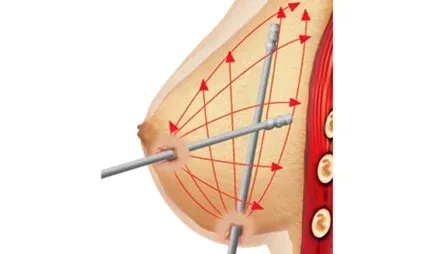
CASE 4. When there is a large amount of fatty tissue: Liposuction Breast Reduction
This method selectively removes only fatty tissue in cases of overall obesity and is suitable when there is more fatty tissue than mammary tissue. Only fat cells are suctioned using a thin cannula tube, leaving almost no surgical traces.
Surgery Information
| Surgery duration: Approximately 2–3 hours | Anesthesia: General anesthesia | Suture removal: 7–10 days | Follow-up visits: 2–3 visits | Recovery period: Daily activities possible after 3–4 days
Pre- and Postoperative Precautions
After Surgery
· Breast pain is most intense during the first 24–28 hours and gradually decreases afterward. · Bandages are removed on the fourth day after surgery. A Surgical bra is usually worn for one month, then changed to a sports bra depending on progress. Wearing a sports bra is recommended for the following three months. · The drainage tube (drainage bulb) is usually removed the day after surgery. · On the day of surgery and the following day, eat soft foods such as thin rice porridge or porridge. · Other than light walks, exercise is permitted after 3 weeks. Public baths, jjimjilbangs, and saunas are permitted after at least 6 weeks. · For smooth-type implants, massage for 10–20 minutes per day is recommended from day 7 through 3 months; textured-type implants should not be massaged. · Sleep on your back, and do not turn onto your side or lie face down for 3 weeks while the tissues are stabilizing. · Take only painkillers and antibiotics prescribed by the hospital, and avoid aspirin-based medications. · Alcohol and smoking are permitted only after 8 weeks following surgery. · For the 1–2 weeks until pain subsides, avoid strenuous activities such as lifting heavy objects and get sufficient rest.
Please Be Sure to Check
Surgical methods and results may vary depending on the individual’s condition and are determined through consultation with a specialist.
 OPERA PLASTIC SURGERY