
Breast Procedures after Pregnancy
from 1,800,000 KRW* VAT Not Included
This is a customized procedure for breasts that have become sagging and reduced in volume after childbirth and breastfeeding, with the appropriate approach selected based on the degree of ptosis, volume, and skin characteristics: implant augmentation, augmentation combined with ptosis correction, or type-specific ptosis correction. Rather than simply removing excess skin, the goal is to reposition sagging breast tissue to its normal location while correcting both volume and shape.
Surgery Overview
Postpartum sagging breast correction is not simply the removal of stretched skin; it is a customized procedure that repositions sagging mammary tissue to its normal location and comprehensively corrects volume and shape to suit the body type. Depending on the degree of ptosis, Implant Breast Augmentation, Vertical Incision or anchor-shaped incision ptosis correction, or periareolar incisions may be selected.

Corrects breasts that have sagged and lost volume after childbirth, restoring volume and firmness. The most common concerns expressed by patients who come in for postpartum Breast Ptosis Correction are, “My breasts became much more saggy and smaller after breastfeeding,” and “They used to be fine, but they have sagged significantly.”
Why does Breast ptosis worsen after breastfeeding?
The breast contains several ligament-like structures that support the breast tissue against the chest wall. As these tissues also undergo aging over time, they can sag and descend. In addition to natural sagging, breastfeeding causes the breasts to enlarge to more than twice their size due to expansion of the mammary glands and ducts during the approximately one-year breastfeeding period. As this expanded state continues, the original skin becomes stretched. When breastfeeding ends, the breasts rapidly decrease in size, while the skin cannot shrink to the same extent, resulting in a wrinkled, deflated-balloon-like appearance and loss of elasticity.
Features of Opera Breast Ptosis Correction
· Removal of stretched skin · Enhanced breast firmness · Repositioning of sagging breast tissue · Ideal breast volume · Balanced breast contour
A customized surgical plan tailored to your concerns considers shape, feel, and firmness together.
Breast Ptosis Self-Assessment
The ideal breast contour and the proportion of a non-sagging breast are assessed by the distance from the inframammary fold to the nipple. · Normal nipple: The nipple is positioned approximately 4–5 cm above the inframammary fold. · Grade 1 breast ptosis: The nipple is at the inframammary fold or has descended within approximately 1 cm below it. · Grade 2 breast ptosis: The nipple has descended 1–3 cm below the inframammary fold. · Grade 3 breast ptosis: The nipple has descended more than 3 cm below the inframammary fold and points downward.
Breast Ptosis Surgery Methods
Breast ptosis correction is determined by the position of the nipple. In general, surgical correction is needed when the nipple is positioned below the inframammary fold. An appropriate customized procedure is performed according to the degree of ptosis, breast volume, skin characteristics, and other factors.
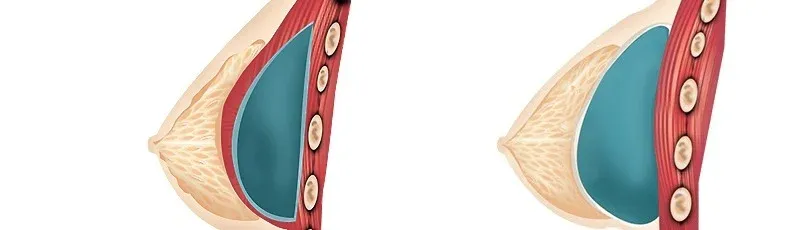
CASE 1. Small breasts with poor firmness and Grade 1–2 breast ptosis: Implant Breast Augmentation
This method increases breast volume using an Implant while simultaneously correcting mild ptosis. The appropriate Implant type and size are selected according to the body type.
CASE 2. Small breasts with severe Grade 3 or higher breast ptosis: Implant Breast Augmentation + ptosis correction
This procedure increases breast volume using an Implant while lifting stretched breast tissue and skin and removing excess tissue through the Vertical Incision method or anchor-shaped incision method.
CASE 3. Correction of ptosis only: Ptosis correction by type
This method corrects only ptosis while maintaining the existing breast volume. The surgical method varies according to the degree of ptosis; stretched breast tissue and skin are lifted, and excess tissue is removed. · Periareolar incisional method (for mild ptosis): Suitable when the breasts are not excessively large and ptosis is mild. Only the perimeter of the areola is incised to remove tissue, resulting in a natural shape with Scars that are barely noticeable. · Vertical Incision method (for moderate ptosis): This method can reduce the desired amount of tissue and correct ptosis. An approximately 4–5 cm vertical incision is made around the areola and down to the inframammary fold to remove stretched mammary tissue, fat, and skin. · Anchor-shaped incisional method (for severe ptosis and large breasts): Effective when a large volume must be reduced and ptosis is severe. It produces the most noticeable before-and-after change and can also correct nipple position.
Surgery Information
| Surgery time: Approximately 1–2 hours | Anesthesia: Sedation or general anesthesia | Suture removal: 7–10 days | Follow-up visits: 2–3 visits | Recovery period: Daily activities possible after 3–4 days
Pre- and Post-Operative Precautions
After Surgery
· Breast pain is most severe during the first 24–28 hours and gradually decreases afterward. · Bandages are removed on the fourth day after surgery. A surgical bra is generally worn for one month, then changed to a sports bra depending on progress. Wearing a sports bra is recommended for the following 3 months. · The drainage tube (drainage bulb) is generally removed the day after surgery. · On the day of surgery and the following day, eat soft foods such as thin rice porridge or porridge. · Exercise other than light walking may be resumed after 3 weeks. Baths, jjimjilbangs, and saunas may be used after at least 6 weeks. · For smooth-type Implants, massage for 10–20 minutes daily is recommended from day 7 through 3 months. Textured-type Implants should not be massaged. · Sleep on your back, and do not turn onto your side or lie face down for 3 weeks while the tissues are stabilizing. · Take only the pain medication and antibiotics prescribed by the hospital, and avoid aspirin-based medications. · Alcohol and smoking may be resumed 8 weeks after surgery. · For the 1–2 weeks until the pain subsides, avoid strenuous activities such as lifting heavy objects and get adequate rest.
Please Be Sure to Check
Surgical methods and results may vary depending on the individual’s condition and are determined through consultation with a specialist.
 OPERA PLASTIC SURGERY